Saturday, July 18, 2015

I2P 的使用

★I2P是啥玩意儿?

  I2P是洋文 Invisible Internet Project 的缩写。官方网站是 http://www.i2p2.de/,维基百科的介绍在“这里”。
  I2P 在很多方面跟 TOR 相似——也是开源软件、也采用分布式、也强调隐匿性。


★I2P有啥特点?


    ◇安全性很强


  为啥说 I2P 的安全性强捏?
  在网络路由方式上,大名鼎鼎的 TOR 是洋葱路由,而 I2P 是大蒜路由。这个大蒜路由,据说是洋葱路由的改进版——安全性更好、隐匿性更强。
  具体好在哪捏?简单说一下。

  TOR 和 I2P 的相同点在于:
都是经过若干个网络节点来加密和中转数据,并防止你的真实 IP 暴露。
  两者的差别在于:
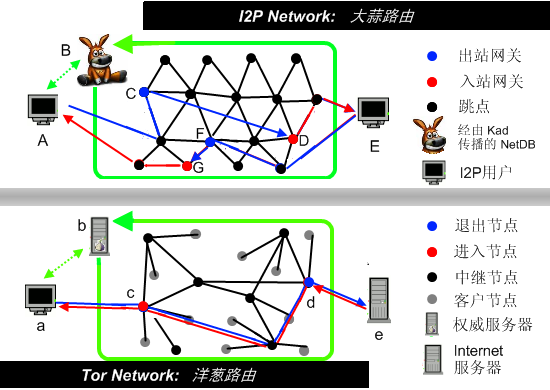
TOR 使用同一条网络链路实现数据的发送和接收;
I2P 使用多条链路发送数据和接受数据——并且发送和接收数据的链路,数量可以是不同的。

  两者在路由方式上的差异对比,请看如下示意图。更多的技术细节,俺就不展开了。大伙儿有兴趣的话,今后单独写篇博文。


     ◇很难被封杀


  在抗封杀方面,I2P 比 TOR 要坚挺。

  先说说 TOR 为啥被天朝封杀:
  TOR 每次启动时,需要先连接到某个 TOR 的目录服务器,获取网络上可用节点的信息。由于目录服务器数量有限,GFW 就把互联网上所有的 TOR 目录服务器的 IP 地址都列入黑名单。后来,TOR 官网提供网桥中继,帮助网友接入 TOR 网络。但是捏,TOR 的网桥中继,数量依然不太多。据说 GFW 专门有人在盯着 TOR 官网更新的网桥中继地址——每次有新的中继地址贴出来,就列入黑名单。经过 GFW 的不懈努力,大部分 TOR 的网桥都被封杀。所以最近2年,TOR 在天朝内不太好使。

  再看看 I2P 为啥封杀不了:
  I2P使用 Kad 算法(用过电驴或电骡的网友,应该听说过)来获取网络节点的信息。这么做有几个好处:
1. 不需要目录服务器
2. Kad算法拿到的节点信息只是整个 I2P 网络的一小部分
3. 每一台运行 I2P 的主机都可以成为中继,帮别人转发数据(类似于 P2P 下载)
  由于上述好处,GFW 很难把所有 I2P 节点都列入黑名单。

    ◇速度很慢


  前面说的这些优点,导致了一个明显的副作用,就是速度慢。
  速度慢是 I2P 为了安全性而不得不付出的代价。据俺亲自测试,0.9版本下载速度最多只有十几 KB/s 而已。如果是以前的版本,似乎还要慢 :(


★简明使用教程


    ◇准备工作


  I2P 的官网老早以前就被 GFW 封了。所以你需要翻墙上“这里”,下载 I2P 的最新版本(目前是 0.9)。
  由于 I2P 是用 Java 编写的,所以你本机需要安装 Java 的运行环境(JDK 或 JRE)。Java 的版本需要 1.5 或者更高(Java 官网的下载页面在“这里”)。

    ◇安装


  安装的第一步会让你选语言,不懂洋文的同学,当然要选中文啦。安装步骤很简单,俺就不浪费口水了。

    ◇运行

  安装完成后,会在开始菜单添加 I2P 的链接。点击相关菜单,就可以启动 I2P。
  I2P 本身不提供 GUI 界面,但是提供 Web 界面。I2P 启动后,你只需在浏览器地址栏输入 http://127.0.0.1:7657/ 即可看到 I2P 的控制界面。

    ◇补种


  注意!这步是关键,看仔细喽!
  前面说了,I2P 是依靠 Kad 网络算法,通过不断扩散,来获取越来越多的节点信息。但是这个 Kad 网络算法不是万能的——它需要一些初始的种子,才能开始工作。在 I2P 的安装包中,已经内置了若干种子(节点信息)。但是天朝的 GFW 早就把这些内置的节点彻底封杀了。所以在天朝,第一次启动 I2P 会找不到网络。这时候就需要补种(补充种子),洋文叫 reseed。

  通常来说,补种只需要做一次,之后你的 I2P 就可以一直联网了。如果你的 I2P 停了很长时间(几个月)没有运行,那么下一次运行的时候,可能会无法联网,这时候就需要再补种。

  补种的方式有如下两个,请根据个人喜好任选一个。

1. 手动下载种子
请翻墙打开官网的种子列表(在“这里”),把页面上列出的大约20个种子下载下来。然后把下载的种子放到本机的 %APPDATA%\I2P\netDb 目录下(这个目录是 I2P 用来存放种子的)。再把 I2P 重新启动一下。

2. 通过代理补种
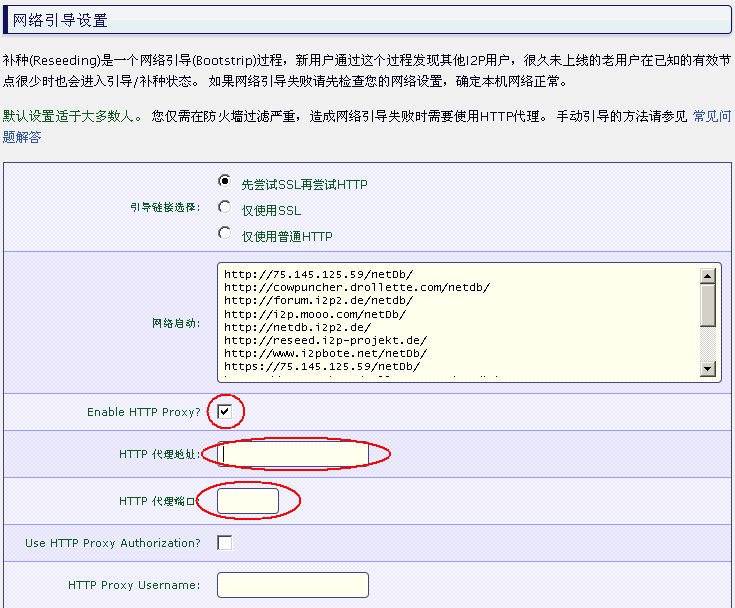
I2P 可以连接到它的官网去补种。但是 I2P 的官网被封。所以你需要在 I2P 的补种界面(http://127.0.0.1:7657/configreseed)添加代理,让 I2P 先暂时利用其它翻墙软件补充种子。
界面截图如下(具体的代理地址和端口,取决于你用的翻墙软件):


填好代理地址和端口之后,要记得点击 "保存修改+立刻开始网络引导" 按钮哦。

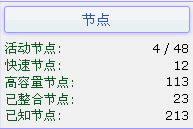
  俺使用的是第二种方法,大约一柱香的功夫,找到200多个种子。请看下图:

 
(图中的 4 / 48 表示:最近一分钟内,跟4个节点有通讯;最近一小时内,跟48个节点有通讯)

  如果 I2P 找到的活动节点太少(小于20个),你就让它一直开着。开的时间越长,它能找到越多的节点。

    ◇设置浏览器


  一旦你的 I2P 接入网络,就可以利用 I2P 的代理来翻墙了。
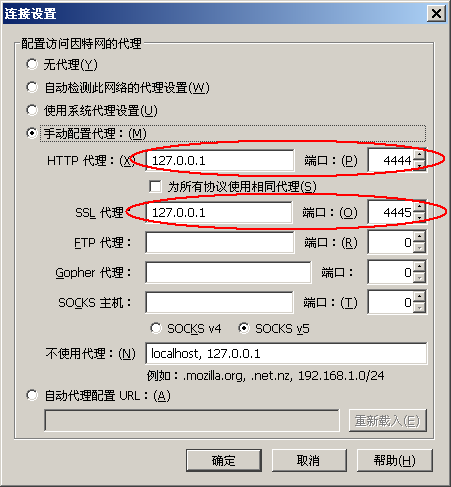
  I2P 默认提供 HTTP 代理(127.0.0.1:4444)和 HTTPS 代理(127.0.0.1:4445),配置如下图(以Firefox为例,其它浏览器大同小异):


    ◇翻墙测试


  为了测试 I2P 的翻墙效果,俺去下载了几个翻墙软件。测试下来,最大下载速度只有 10 KB/s 左右。连接不稳定,有时候下载到一半就断掉。

  假如哪位同学也尝试了 I2P,欢迎到俺博客留言,反馈你的使用情况(尤其是网速的情况)。


★总结——I2P能用来干啥?


  在本文的末尾,俺稍微总结一下 I2P 的几种用途。

    ◇应急情况下,获取其它翻墙工具


  对于普通的网友,平时是不需要用 I2P 的(因为速度太慢)。但是你最好在手头留一个可用的 I2P 软件,以防万一。说不定哪天,朝廷加大网络封锁力度,导致你正在用的翻墙软件失效,这时候你就可以用 I2P 去下载其它翻墙软件的最新版本。

   ◇匿名上网


  俺个人觉得,用 TOR 搞多重代理,已经足以在天朝匿名上网了(虽然在天朝无法直接用 TOR,但 TOR 可以在其它翻墙工具的配合下建立连接)。不过捏,少数比较挑剔的网友,会嫌 TOR 还不够安全。对这些网友来说,I2P 是 TOR 的更安全替代品。

    ◇使用 I2P 应用


  其实拿 I2P 来做代理,是杀鸡用牛刀。 当初开发I2P 的 主要目的,并不是为了提供翻墙代理,而是为了提供 “暗网”(洋文叫 darknet)。所谓的“暗网”,就是一个完全隐匿的,不受政府监管的,也不会被政府破坏的地下互联网。既然是“地下互联网”,常见的互联网应用(比如:邮件、论坛、聊天、博客、文件共享),I2P 网络上都有。在 I2P 网络使用这些应用,你的真实 IP 地址不会暴露,减低了跨省追捕的风险。
  举个例子:假如你想成立一个地下组织,密谋颠覆朝廷。那就可以考虑让组织内的成员都采用 I2P 的网络应用——对隐藏真实 IP 很有效。
  至于如何在 I2P 上使用各种应用,不是本文的主题。有兴趣的同学,请看官网的“中文 FAQ”。

  最后,祝愿更多的天朝网友掌握翻墙姿势,早日呼吸到互联网上自由的空气。

-----------------------------------------------------------------------------
Quote:
版权声明
本博客所有的原创文章,作者皆保留版权。转载必须包含本声明,保持本文完整,并以超链接形式注明作者编程随想和本文原始地址:
http://program-think.blogspot.com/2012/06/gfw-i2p.html

Friday, April 24, 2015

关于近期社保数据泄露..

首先说明:我是一名IT男屌、打杂工、专业搬砖,业余爱好:装逼、瞎折腾、业余白帽子。非常乐意和论坛的朋友一起学习交流...

本来网络安全是一件很严肃的事情,但是偏偏国内网络安全风险确是遍地开花。在两个比较知名的漏洞提交平台乌云、360补天每天都会有大量漏洞提交,其中不缺乏上市企业、政府机构、教育机构等影响范围比较大的漏洞。
为何每天都有数百成千的漏洞爆出,这着实让人感到震惊。很多人都说计算机行业已经处于饱和状态,那说明IT人员很多哇...但是真正作为一名合格的IT管理员又有多少呢?
当你在每天忙碌着写各种文案、标书、网络设计的同时是否有过关注网络安全?还只是单纯的停留在防火墙、上网认证等那些硬件配置上?
网络安全本身就是一个很广的范围,软件程序漏洞、网络设计漏洞、WEB站点漏洞、硬件设计缺陷......其实这些都是和网络相关,那么作为一名IT管理员是否应该经常关注这些安全风险同时并结合自身网络环境进行安全巡查修补。答案是很多都忽略这点...
网络的不断发展,新技术不断更新,需要不断学习来掌握其中知识。本来就已经很疲惫的IT人员还得面临着各种网络安全威胁,说到底,这其实还是一种意识和习惯问题。就拿这次大规模政府机构敏感数据泄露问题来说,其实很多都不是比较高深的网络安全风险、甚至是已经在网络上流传开的漏洞,却依然造成了如此之大的数据泄露风险。很简单,就是因为企业、机构的IT管理员平常都不关注网络安全,有些甚至根本不知道入侵、渗透、注入等名词。

举个真实例子来讲:

某天在访问某企业的官网时,通过了解这家企业还是做的还是蛮大的,有很多大型项目、自主开发的程序。既然是大公司就来个安全检测套餐吧,一番云雨后并没有什么收获其中检测了OA、邮件系统、官方网站、及其他一些杂项...好吧突发奇想,看到有ssl vpn果断尝试下。
duang的一下就进去了,吓得我赶紧穿好了裤子开上台式拖拉机。居然VPN有弱口令 test  admin 两个账号。抽根软白沙压压惊...因为vpn中发布了8个内网web程序,接着再是一番云雨拿到一台财务报表服务器,很显然这程序已经是烂大街的洞了,居然管理员没做任何修复,也许觉得是内网吧。duangduangduang...顺利提权进入服务器,因为有了VPN,同样处于内网环境。给3389端口来了一记组合拳,顺利拿下了服务器并获取了管理员密码...发现这台服务器上面数据不是很多。于是乎想着来个内网渗透吧...各种扫描端口尝试攻击,最后是又拿到了两台服务器。这尼玛有点诡异啊...居然管理员账号都是一样的,好吧瞬间懂了这管理员应该是领导级的,还是域账号...又是duangduangduang接下来的事情让你更吃惊,总共内网35台服务器...每台都可以用这个账号进行登录。数据量已经扰乱了我的眼...各种项目文件、标书、商业机密资料、还有核项目文件....顺势整个内网设备FW、ROUTER、Switch、存储、虚拟化都被拿下了。好吧已经是凌晨3点了,再来一根软白沙压压惊。看着这么多数据,动不得,只能围观一下...毕竟是安全检测点到为止...因为我还想去外面的世界走走

通过上面这个案例其实就已经暴漏出了企业网络中存在着各种安全风险,也许你外围安全做的很好,但依旧还是存在着家贼的风险。这样的案例并不少,至少我也见了很多了...

导致这些数据泄露的原因,头奖依旧要属于弱口令、其次是web程序设计缺陷存(SQL注入、XSS)、然后是服务器配置不当(随意开放端口、目录浏览)、接着是不作为(满足现状,使用老旧程序、不会及时更新修补)。和网络技术一样,入侵手段也是多种多样,每一样都会给你致命一击。

希望管理员们能够引起重视,加强自身技术的同时也不要忘记网络安全,要养成良好的安全意识,加强自家企业的网络安全,定期巡检写报告。网络安全不是一朝一夕,是一个持久性的过程。

好久都没写这么多文字...感觉有点自己都看不下去的样子,如有不对的地方还请见谅。因为我也只是一个业余的白帽子,也是一个底层IT屌丝。

我就是Marlboro,那么我也头一次上新闻混个脸熟....O(∩_∩)O哈哈哈~

这一段,小编把我写到高潮了...

让Marlboro印象尤为深刻的是,前段时间对某省卫计委的一次安全检测只用了30分钟。“全省人口的医保信息、医保卡金额、医疗药品等等敏感数据就泄露了,当然其中也有我的”,他说,湖南省卫计委后来低调修复,没有在平台上更新告知白帽子们。

新闻-搜狐:http://news.sohu.com/20150424/n4 ... qq-pf-to=pcqq.group
新闻-凤凰:http://tech.ifeng.com/a/20150424/41066412_0.shtml
2.png 

Thursday, December 4, 2014

300 Unknown Malware. Nailed with Check Point Threat Prevention Industry's best catch rate from Check Point Website

From Check Point page, found some interesting words based on recent 300 Unknown malware test:


In recent benchmark testing, 300 malicious files were scanned through Check Point Threat Emulation and other competitive products. The results found that Check Point outperformed all of the others.


HOW WE STACK UP
TO THE COMPETITION


SECURITY FINDINGS
ONLY Check Point caught ALL
300 Unknown Malware files.
Malware comes in all sizes.
Palo Alto Networks limits you to 1MB for PDF files.
Prevention
is more important than detection.
Palo Alto Networks and Fortinet only detect but cannot prevent unknown malware.
It is critical to scan inside SSL traffic.
FireEye does not scan inside SSL traffic.
Archived files need to be inspected.
Palo Alto Networks could not inspect .rar files.
Malware can propagate very quickly.
Real-time protection is required
Palo Alto Networks takes 30 minutes to update signatures.
Fortinet takes even longer.
Multi-protocol scanning
in one appliance
saves on total cost of ownership. 
FireEye needs a separate appliance for email protection
and for web protection.


Reference:

300 Unknown Malware. Nailed with Check Point Threat Prevention Industry's best catch rate


Friday, August 1, 2014

Advanced persistent threat

Advanced persistent threat

From Wikipedia, the free encyclopedia
Jump to: navigation, search
Advanced Persistent Threat (APT) APT is a set of stealthy and continuous computer hacking processes, often orchestrated by human(s) targeting a specific entity. APT usually targets organizations and or nations for business or political motives. APT processes require high degree of covertness over a long period of time. As the name implies, APT consists of three major components/processes: advanced, persistent, and threat. The advanced process signifies sophisticated techniques using malware to exploit vulnerabilities in systems. The persistent process suggests that an external command and control is continuously monitoring and extracting data off a specific target. The threat process indicates human involvement in orchestrating the attack.[1]
APT usually refers to a group, such as a government, with both the capability and the intent to persistently and effectively target a specific entity. The term is commonly used to refer to cyber threats, in particular that of Internet-enabled espionage using a variety of intelligence gathering techniques to access sensitive information,[2] but applies equally to other threats such as that of traditional espionage or attack.[3] Other recognized attack vectors include infected media, supply chain compromise, and social engineering. Individuals, such as an individual hacker, are not usually referred to as an APT as they rarely have the resources to be both advanced and persistent even if they are intent on gaining access to, or attacking, a specific target.[4]


History and targets[edit]

First warnings against targeted, socially-engineered emails dropping trojans to exfiltrate sensitive information were published by UK and US CERT organisations in 2005, although the name "APT" was not used.[5] The term "advanced persistent threat" is widely cited as originating from the Air Force in 2006[6] with Colonel Greg Rattray frequently cited as the individual who coined the term.[7]
The Stuxnet computer worm, which targeted the computer hardware of Iran's nuclear program, is one example. In this case, the Iranian government might consider the Stuxnet creators to be an advanced persistent threat.
Within the computer security community, and increasingly within the media, the term is almost always used in reference to a long-term pattern of sophisticated hacking attacks aimed at governments, companies, and political activists, and by extension, also to refer to the groups behind these attacks.[citation needed] Advanced persistent threat (APT) as a term may be shifting focus to computer based hacking due to the rising number of occurrences. PC World reported 81 percent increase from 2010 to 2011 of particularly advanced targeted computer hacking attacks.[8]
A common misconception[who?] associated with the APT is that the APT only targets Western governments. While examples of technological APTs against Western governments may be more publicized in the West, actors in many nations have used cyberspace as a means to gather intelligence on individuals and groups of individuals of interest.[9][10][11] The United States Cyber Command is tasked with coordinating the US military's response to this cyber threat.
Numerous sources have alleged that some APT groups are affiliated with, or are agents of, nation-states.[12][13][14] Businesses holding a large quantity of personally identifiable information are at high risk of being targeted by advanced persistent threats, including:[2]
  • Higher education[15]
  • Financial institutions

APT characteristics[edit]

Bodmer, Kilger, Carpenter and Jones defined the following APT criteria:[16]
  • Objectives — The end goal of the threat, your adversary
  • Timeliness — The time spent probing and accessing your system
  • Resources — The level of knowledge and tools used in the event (skills and methods will weigh on this point)
  • Risk tolerance — The extent the threat will go to remain undetected
  • Skills and methods — The tools and techniques used throughout the event
  • Actions — The precise actions of a threat or numerous threats
  • Attack origination points — The number of points where the event originated
  • Numbers involved in the attack — How many internal and external systems were involved in the event, and how many people's systems have different influence/importance weights
  • Knowledge source — The ability to discern any information regarding any of the specific threats through online information gathering (you might be surprised by what you can find by being a little proactive)

APT life cycle[edit]

Diagram depicting the life cycle staged approach of an advanced persistent threat (APT) which repeats itself once complete.
Actors behind advanced persistent threats create a growing and changing risk to organizations' financial assets, intellectual property, and reputation[17] by following a continuous process:
  1. Target specific organizations for a singular objective
  2. Attempt to gain a foothold in the environment, common tactics include spear phishing emails.
  3. Use the compromised systems as access into the target network
  4. Deploy additional tools that help fulfill the attack objective
  5. Cover tracks to maintain access for future initiatives
The global landscape of APTs from all sources is sometimes referred to in the singular as "the" APT, as are references to the actor behind a specific incident or series of incidents.[citation needed]
In 2013, Mandiant presented results of their research on alleged Chinese attacks using APT methodology between 2004 and 2013[18] that followed similar lifecycle:
  • Initial compromise — performed by use of social engineering and spear phishing, over email, using zero-day viruses. Another popular infection method was planting malware on a website that the victim employees will be likely to visit.
  • Establish Foothold — plant remote administration software in victim's network, create network backdoors and tunnels allowing stealth access to its infrastructure.
  • Escalate Privileges — use exploits and password cracking to acquire administrator privileges over victim's computer and possibly expand it to Windows domain administrator accounts.
  • Internal Reconnaissance — collect information on surrounding infrastructure, trust relationships, Windows domain structure.
  • Move Laterally — expand control to other workstations, servers and infrastructure elements and perform data harvesting on them.
  • Maintain Presence — ensure continued control over access channels and credentials acquired in previous steps.
  • Complete Mission — exfiltrate stolen data from victim's network.
In incidents analysed by Mandiant, the average period over which the attackers controlled the victim's network was one year, with longest – almost five years.[18] The infiltrations were allegedly performed by Shanghai-based Unit 61398 of People's Liberation Army. Chinese officials have denied any involvement in these attacks.[19]

Terminology[edit]

Definitions of precisely what an APT is can vary, but can be summarized by their named requirements below:[3][4][20]
  • Advanced – Operators behind the threat have a full spectrum of intelligence-gathering techniques at their disposal. These may include computer intrusion technologies and techniques, but also extend to conventional intelligence-gathering techniques such as telephone-interception technologies and satellite imaging. While individual components of the attack may not be classed as particularly "advanced" (e.g. malware components generated from commonly available do-it-yourself malware construction kits, or the use of easily procured exploit materials), their operators can typically access and develop more advanced tools as required. They often combine multiple targeting methods, tools, and techniques in order to reach and compromise their target and maintain access to it. Operators may also demonstrate a deliberate focus on operational security that differentiates them from "less advanced" threats.
  • Persistent – Operators give priority to a specific task, rather than opportunistically seeking information for financial or other gain. This distinction implies that the attackers are guided by external entities. The targeting is conducted through continuous monitoring and interaction in order to achieve the defined objectives. It does not mean a barrage of constant attacks and malware updates. In fact, a "low-and-slow" approach is usually more successful. If the operator loses access to their target they usually will reattempt access, and most often, successfully. One of the operator's goals is to maintain long-term access to the target, in contrast to threats who only need access to execute a specific task.
  • Threat – APTs are a threat because they have both capability and intent. APT attacks are executed by coordinated human actions, rather than by mindless and automated pieces of code. The operators have a specific objective and are skilled, motivated, organized and well funded.

Mitigation strategies[edit]

There are 100s of millions of malware variations, which make is extremely challenging to protect organizations from APT. While APT activities are stealthy and hard to detect, the command and control network traffic associated with APT can be detected at the network layer level. Deep log analyses and log correlation from various sources can be useful in detecting APT activities – it’s all about the logs. Agents can be used to collect logs (TCP and UDP) directly from assets into a syslog server. Then a Security Information and Event Management (SIEM) tool can correlate and analyze logs. While it is challenging to separate noises from legitimate traffic, a good log correlation tool can be used to filter out the legitimate traffic, so security staff can focus on the noises
Saturday, July 19, 2014

The 11 scariest digital security stories of 2014 (so far)

http://www.pcworld.com/article/2364275/the-8-scariest-security-stories-of-2014-so-far.html

1. Bad moon rising

Barely halfway through 2014, the year's already poised to become the scariest yet for digital security—topping even 2013's massive Target breach. We’ve seen hacks against big-name retailers like eBay, Michael’s, and Neiman Marcus—plus hotels, online forums, and numerous other websites. The current tally of compromised credit cards from major breaches is closing in on 5 million, and online accounts?—half a billion.
Beyond active attacks, go-to encryption tool TrueCrypt was lost, and we've suffered through the single biggest web security lapse ever. As we close in on the halfway point for 2014, here are the 10 biggest security stories so far.


2. Heartbleed bleeds the web

Thousands of major websites worldwide scrambled in April after a nasty little flaw turned up in OpenSSL—a widespread tool for securing online communications, including HTTPS websites. Dubbed Heartbleed, this devastating bug threatened to expose usernames and passwords, user data, and even the SSL keys sites use to securely identify themselves. The problem was widespread: affected sites included Instagram, Netflix, and Tumblr.
Although it was a serious flaw, Heartbleed also inspired several major tech companies to fund poorly-supported open source projects. The first group to receive assistance—surprise!—was the OpenSSL Software Foundation.

3. TrueCrypt shuts up shop

In May, customers were shocked to be suddenly rerouted from the TrueCrypt encryption software's website to the project’s SourceForge page. There, they found this message: “WARNING: Using TrueCrypt is not secure as it may contain unfixed security issues.”
At first, it looked like a hoax or a hack, because TrueCrypt's advice to switch to Microsoft’s closed-source BitLocker encryption tool was diametrically opposed to the project's ideals. Several weeks later, however, TrueCrypt’s demise appears to be real. There are attempts to resurrect the project under new management, even as rumors about hidden Latin messages from TrueCrypt's developers swirl.

4. Breaches, breaches, and more breaches

A security review wouldn’t be complete without a roundup of major data breaches. EBay is the most notable victim: In May, the site announced a devastating data breach that included names, email and home addresses, phone numbers, dates of birth, and encrypted passwords. Reports put the number of affected users around 145 million.
Hobby retailer Michael’s joined eBay in the data breach Hall of Shame, along with AOLAvast's online forumsHoliday Inn and Marriott Hotels, and Neiman Marcus. Restaurant chain P.F. Chang’s recently announced it was also investigating a data breach. And oh yeah, another 360 million usernames and passwords surfaced on hacker forums in February. Ugh.


5. La Oops

But sometimes, a breach deserves individual recognition—like the hack that Seagate-owned LaCie announced in April. The hard drive and peripheral storage maker said its online storefront had endured a whopping year-long data heist from March 27, 2013 to March 10, 2014. LaCie said it wasn’t sure what kind of data had been pilfered, but it may have included customer names, email addresses, credit card numbers, and card expiration dates. Crazy.

6. Ransom goes rampant

If 2013 was the year of the personal data breach, then 2014 is shaping up to be the year of digital hostages and ransomware. Malicious software that threatens to ruin your PC if you don’t pay a certain amount of money is an old game, but hackers upped the stakes in the early part of 2014. In late May, iOS users around the world woke up to find their iDevices locked via Apple's Find My iPhone service, with hackers demanding money to restore them. Then in June, security firm ESET found the first example of file-encrypting ransomware on Android. Sites like project-management web app Basecamp were also held ransom unless they paid up to stop distributed denial of service (DDoS) attacks.

7. GnuTu Fail

Heartbleed wasn’t the only significant SSL/TLS bug in 2014. In February and March, both Apple and the Linux community were scrambling to fix flaws in their implementations of online security protocols. In Apple’s case, someone had mistakenly included an extra 'goto fail' programming statement that left encrypted data sent via SSL/TLS open to capture by hackers.
In the Linux case, the GnuTLS library had a programming flaw exposing user data to potential breaches, similar to Apple’s 'goto fail' problem. In the case of GnuTLS, however, it’s suspected the programming flaw existed for as long as 10 years—prompting Linux community leaders to say, “Huh, Gnu knew?” ( Groan —Ed.)

8. Pliable crypto-currency

Bitcoin security hit a road bump in February: A flaw dubbed “transaction malleability” led to attacks against several Bitcoin exchanges, according to Bitcoin news site Coindesk. The flaw could theoretically allow an attacker to substitute a phony transaction for the original one, thus redirecting Bitcoins from the intended recipient to the attacker.
Transaction malleability was serious enough that it was an early theory as to why embattled Bitcoin exchange Mt. Gox closed its doors. Mt. Gox’s problems were later revealed to go deeper than a software bug, however, and a fix addressing transaction malleability was issued in March.

9. Outlook snoop

Government agents aren’t the only snoops who might be plundering your Outlook.com inbox. Microsoft might also take a peek…at least if you’re up to no good. In March, Microsoft ‘fessed that it snooped on the personal email of both a blogger and a former employee, seeking evidence that the employee was leaking proprietary company information to the blogger. (To its credit, Microsoft revamped its privacy policy after the backlash.)
The case highlights how American digital due-process is woefully inadequate. After all, private emails sitting on third-party servers should be considered just as private as those love letters stashed in the back of your closet.

10. Gameover for Gameover botnet

Two positive stories offer some hope.
In June, a global law-enforcement coalition temporarily disrupted a nasty botnet called Gameover ZeuS. Infected Windows PCs were harvested for personal data and also used to distribute Cryptolocker ransomware.
Gameover includes a peer-to-peer component, as well as online proxy servers and strong encryption, according to Krebs on Security. Gameover affects an estimated 500,000 to one million PCs worldwide, and the disruption—dubbed ‘Operation Tovar’—only served as a chance to clean up infected PCs. U.S authorities indicted Evgeniy Mikhailovich Bogachev, 30, of Anapa, Russia, on several criminal charges related to operating the botnet.

11. Google's end-to-end revenge

Revenge is a dish best served cold, and Google made sure its vengeance pie was well and truly cooled before serving it up to the National Security Agency. As the fallout over Edward Snowden's NSA revelations continues, Google announced it wanted to make end-to-end encryption for webmail easier to use with a new Chrome extension. Called End-to-End, the extension is currently in a public alpha phase and not yet ready for wide release. When it goes live, however, it will be one of several new projects promising to keep your most private emails secure from prying eyes and snooping government agencies.

The 5 biggest data breaches of 2014 (so far)


http://www.pcworld.com/article/2453400/the-biggest-data-breaches-of-2014-so-far.html

The 5 biggest data breaches of 2014 (so far)

In the battle to keep your personal information private, it’s not just hackers you have to worry about but lax security and stupidity.
A survey of data breaches in the first six months of this year shows an increasing number of incidents in which data, including names and addresses, credit card and Social Security numbers, and medical records was lost to criminals or exposed.
More reading: The 8 scariest security stories of 2014 (so far), which examines the greater security landscape.
In many of the cases, the breaches were put down to poor data security practices or simple errors: like St. Vincent Breast Center in Indianapolis sending 63,000 letters containing information on upcoming appointments to the wrong people, or Stanford Federal Credit Union accidentally attaching a file with information on 18,000 customers to an email, or the thousands of paper medical records dumped at a public incineration site in York, Pennsylvania.
In other cases, laptops or thumb drives containing information were stolen—in some cases with apparently nothing more than the login password to protect the data.
One of the biggest such cases involving laptop theft occurred at the Torrance, California, office of Sutherland Healthcare Solutions, which lost eight laptops in a February break-in. The laptops contained medical information on almost 400,000 people in California, and their theft has sparked lawsuits.
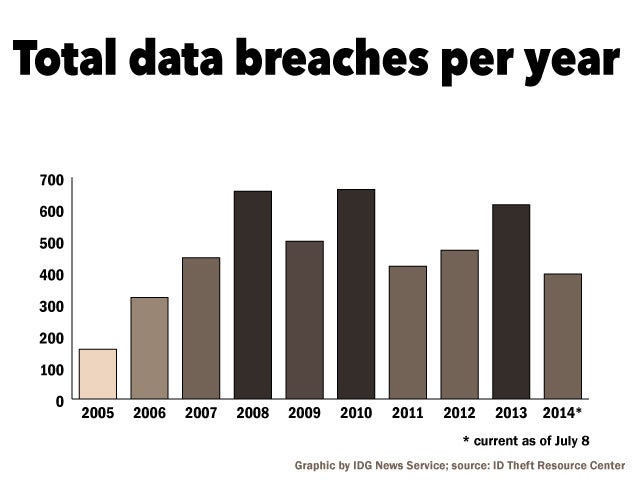
new data breach graphic IDGNS

Data breaches on the rise

According to the Identity Theft Resource Center, there have already been 395 data breaches in the U.S. this year that have been reported to regulators or covered by media outlets, a 21 percent increase over the same period last year.
Here are the top five data breaches of the first half of 2014, with an extra entry for eBay. That breach appears to be one of the largest yet, but the exact extent of the problem has not yet been divulged by the company, so it’s difficult to quantify how big it actually was.
eBay
The online retailer suffered one of the biggest data breaches yet reported by an online retailer. Attackers compromised a “small number of employee log-in credentials” between late February and early March to gain access to the company’s network and, through it, compromised a database that contained customer names, encrypted passwords, email addresses, physical addresses, phone numbers and dates of birth. The breach is thought to have affected the majority of the company’s 145 million members, and many were asked to change their passwords as a result.
Michaels Stores
The point-of-sale systems at 54 Michaels and Aaron Brothers stores “were attacked by criminals using highly sophisticated malware” between May 2013 and January 2014. The company said up to 2.6 million payment card numbers and expiration dates at Michaels stores and 400,000 at Aaron Brothers could have been obtained in the attack. The company received confirmation of at least some fraudulent use.
Montana Department of Public Health and Human Services
Triggered by suspicious activity, officials conducted an investigation in mid-May that led to the conclusion that a server at the Montana Department of Public Health and Human Services had been hacked. The server held names, addresses, dates of birth and Social Security numbers on roughly 1.3 million people, although the department said it has “no reason to believe that any information contained on the server has been used improperly or even accessed.”
Variable Annuity Life Insurance Co.
A former financial adviser at the company was found in possession of a thumb drive that contained details on 774,723 of the company’s customers. The drive was provided to the company by law enforcement as the result of a search warrant served on the former adviser. The thumb drive included full or partial Social Security numbers, but the insurance company said it didn’t believe any of the data had been used to access customer accounts. It’s not the first time the company has lost data on a thumb drive. In 2006, it wrapped up a lawsuit against a former financial adviser for downloading “confidential customer information” onto “a portable flash drive.”
Spec’s
A 17-month-long “criminal attack” on the Texas wine retailer’s network resulted in the loss of information of as many as 550,000 customers. The intrusion began in October 2012 and affected 34 of the company’s stores across the state. It continued until as late as March 20 this year, and the company fears hackers got away with customer names, debit or credit card details, card expiration dates, card security codes, bank account information from checks and possibly driver’s license numbers.
St. Joseph Health System
A server at the Texas health care provider was attacked between Dec. 16 and 18 last year. It contained “approximately 405,000 former and current patients’, employees’ and some employees’ beneficiaries’ information.” This included names, Social Security numbers, dates of birth, medical information and, in some cases, addresses and bank account information. As with many other hacks, an investigation wasn’t able to determine if the data was accessed or stolen.
Correction: A chart attached to this story was updated at 4:58 PM to correct a labeling error.

Wednesday, April 2, 2014

Russians Suspected In ‘Uroburos’ Digital Espionage Attacks

http://www.techweekeurope.co.uk/news/russian-intelligence-uroburos-malware-140494

Russian intelligence linked to super-sophisticated rootkit targeting high-profile organisations and nation states
On  by Thomas Brewster 0
Russian government hackers are suspected of creating a highly-sophisticated piece of malware designed tosteal files from nation states’ digital infrastructure.
The Uroburos malware, named after an ancient symbol depicting a serpent or dragon eating its own tail that recently appeared in the Broken Sword 5 video game, worked in in peer-to-peer mode, meaning it can move across machines even if they’re not connected to the public Internet.
G-Data said Uroburos was “one of the most advanced rootkits we have ever analysed in this environment”.

ouroboro uroburos malware russian dragon eating tail © Eugene Ivanov ShutterstockRussian intelligence involved?

It works on both 32-bit and 64-bit Microsoft Windows machines, again pointing to a well-funded effort. It’s likely the Uroburos attacks went undetected for at least three years, as a sample of a rootkit driver was dated back to 2011.
“The development of a framework like Uroburos is a huge investment. The development team behind this malware obviously comprises highly skilled computer experts, as you can infer from the structure and the advanced design of the rootkit,” G-Data said.
“The design is highly professional; the fact the attackers use a driver and a virtual file system in two separate files which can only work in combination, makes the analysis really complicated. One needs to have the two components to correctly analyze the framework. The driver contains all of the necessary functionality and the file system alone simply cannot be decrypted.
“The network design is extraordinarily efficient, too; for an incident response team, it is always complicated to deal with peer-to-peer infrastructure. It is also hard to handle passive nodes, because one cannot quickly identify the link between the different infected machines.”
The Russian connection was made after researchers from G-Data discovered plenty of Russian-language strings in the code. They also found the malware searching for the presence of Agent.BTZ, malware used in attacks on the US in 2008, which were said to have been carried out by Russian spies.
The Agent.BTZ attack was initiated when a USB stick was deliberately left in a parking area belonging to the United States Department of Defense.
“We believe that the team behind Uroburos has continued working on even more advanced variants, which are still to be discovered,” G-Data added.
“We are sure of the fact that attacks carried out with Uroburos are not targeting John Doe but high profile enterprises, nation states, intelligence agencies and similar targets.”


俄罗斯在克里米亚的军事活动正成为全世界的焦点,而它在幕后的网络间谍战也正有条不紊的继续着。俄罗斯政府黑客被怀疑是间谍软件Uroburos的幕后作者。

Uroburos是一种p2p传播的恶意程序,被安全公司G-Data称之为至今发现的最先进rootkit恶意程序之一。Uroburos的间谍活动至少秘密进行了三年,G-Data称它的开发需要巨大的资金投入和经验丰富的专家。程序的源代码中包含了俄语字符串,并被发现在搜索另一个间谍软件Agent.BTZ,Agent.BTZ是涉及渗透进五角大楼的恶意程序。

俄罗斯悄然打响网络间谍战,Uroburos程序幕后作者

俄罗斯政府黑客被怀疑开发了一款高度复杂的恶意软件,用来从一些国家政府的基础数字设施窃取文件。

这款名为Uroburos的恶意软件是根据一种古老的符号——乌洛波洛斯来命名的,其形象符号是最近出现在冒险游戏断剑5中的衔尾蛇。这款恶意软件通过P2P模式运行,这也就意味着即使没有连接公网,这款软件仍然可以在机器间传播。

全球顶级杀软G-Data表示这是迄今为止发现的最先进的rootkit恶意程序之一。

俄罗斯情报部门参与?

俄罗斯悄然打响网络间谍战,Uroburos程序幕后作者

它可以适用于32位和64位系统。而Uroburos的间谍活动至少可以追溯到2011年,已经运行了至少三年而未被发现。

G-Data表示:

“像Uroburos这样框架的开发需要巨大的投资,我们从rootkit的结构和先进的设计推断,这款恶意软件的开发团队中显然有着大量经验丰富的计算机专家。”

“这种设计太专业了,事实上攻击者将驱动和虚拟文件系统完全独立开了,只有在这两部分组合起来才能正常工作,这就导致了对其分析起来便非常复杂。要想分析这个框架只有将两个组件正确组合起来。而驱动所包含的必要功能与单独的文件系统是无法实行解密的。”

“这种网络设计太高效了,对于一个事件响应来说,要完成p2p基础设施的处理往往是非常复杂的。因为不能快速识别不同受感染机器之间的联系,这就导致被动节点很难被处理。”

G-Data的研究者在这款软件的源代码中发现了大量的俄语字符,并被发现在搜索另一个间谍软件Agent.BTZ(一款在2008年用于渗透五角大楼的恶意软件),这也就直指俄罗斯的间谍活动行为。

我们仍记得,当Agent.BTZ攻击发起时,有一个USB存储承载着Agent.BTZ在美国国防部的电脑间“流窜”。早在2008年,由于这种软件通过“U盘”来疯狂传播,因此美军暂时禁止官兵在任何军方电脑上使用U盘或者其他外置存储装置。

“我们相信,Uroburos的背后开发团队会继续致力于开发更先进的恶意软件变种,当然这还有待于我们进一步发现”,G-Data补充说明。

“我们可以确定的事实是Uroburos的目标绝不是张三李四王二麻子某个个人,而是高端企业、政府机关、情报机构和其他相关部门。”